


Illicit drug production in the European Union is a persistent and evolving phenomenon, encompassing a wide range of substances and production methods. The EUDA supports EU-level understanding of illicit drug production by bringing together information on dismantled production sites, production methods and related incidents. This work contributes to a coherent and comparable picture of where and how drug production takes place in the European Union and how patterns evolve over time. In addition, the EUDA monitors developments in drug precursor markets to support the early identification of emerging risks associated with these chemicals and to support informed responses at EU level.
On this page you can find more information on the EUDA’s work in this area.

Overview
Illicit drug production in the European Union is a persistent and evolving phenomenon, encompassing a wide range of substances and production methods. Production within the European Union focuses primarily on synthetic stimulants, including amphetamine, MDMA, methamphetamine and synthetic cathinones, while evidence of synthetic opioid production on EU territory remains very limited. Manufacturing takes place in a variety of settings, ranging from large, industrial-scale facilities to small, fixed or mobile laboratories, reflecting a flexible and adaptive production landscape. Production serves both EU markets and non-EU destinations.
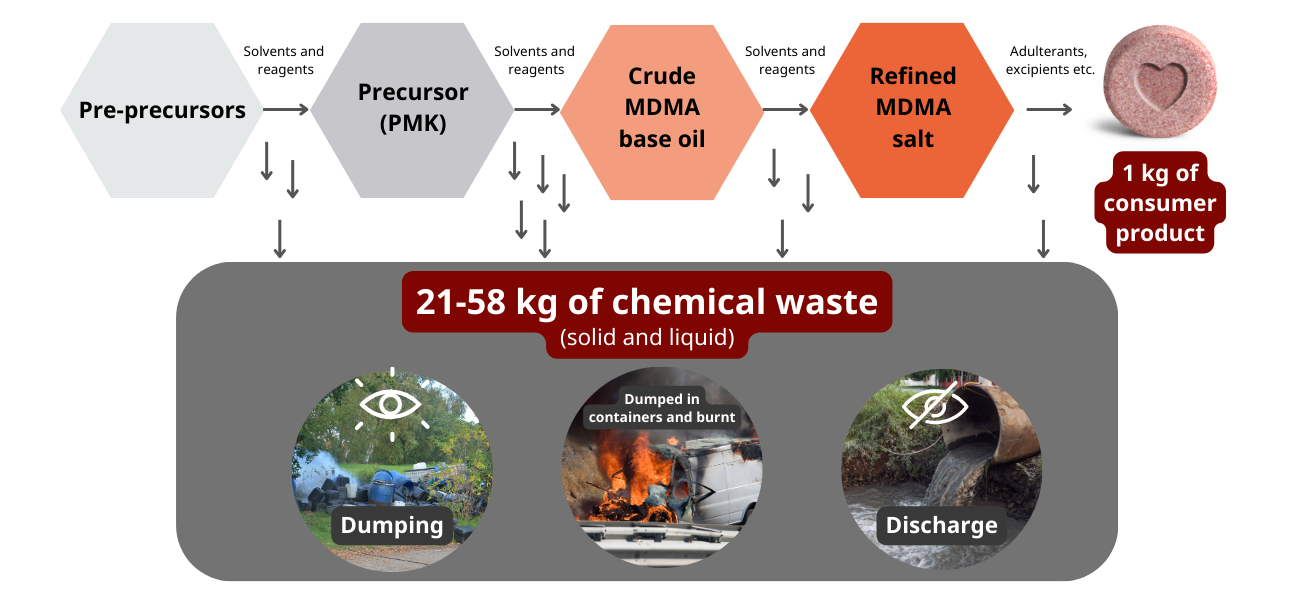
Illicit drug production generates substantial quantities of chemical waste (see Figure 1). This waste is frequently improperly stored or illegally disposed of, contributing to soil and water contamination and creating significant clean-up and remediation challenges for local authorities. Production and storage sites may also pose risks of fire, explosion and exposure to hazardous substances, with potential consequences for nearby communities.
Show a text version of the above graphic
The production of MDMA involves several stages, typically beginning with alternative chemicals, which are synthesised into the precursor PMK. This is then converted into crude MDMA base oil, followed by refinement into MDMA salt. During all these steps, solvents and reagents are used. For the final step, adulterants, excipients and other chemicals are used to produce the final consumer product. The production of 1 kilogram of ecstasy tablets generates a significant environmental burden, producing between 21 and 58 kilograms of solid and liquid chemical waste. This waste is often irresponsibly discarded, with common disposal methods including illegal dumping in natural environments, incineration in containers and direct discharge into waterways.
Illicit drug production in the European Union is closely linked to the availability, diversion and trafficking of chemical precursors and auxiliary substances. Key precursor chemicals are often sourced from abroad, while a wide range of other substances used in production are obtained from within the European Union. Criminal networks involved in production regularly adapt manufacturing processes and substitute precursor chemicals in response to controls, presenting ongoing challenges for monitoring, regulation and enforcement.
In this context, the EUDA supports policymakers, law enforcement authorities, health practitioners and operational partners by providing a shared evidence base, analysis of trends and emerging risks, and guidance relevant to both operational and policy responses. This work brings together data and intelligence on illicit drug production and precursor markets across the European Union.
As of 2024, the EUDA has been assigned a specific role under EU law (Article 14 of the EUDA Regulation), in monitoring the diversion and trafficking of drug precursors and in supporting the European Commission in the implementation of EU legislation on drug precursors.
Illicit drug production
The EUDA supports EU-level understanding of illicit drug production by bringing together information on dismantled production sites, production methods and related incidents. This work contributes to a coherent and comparable picture of where and how drug production takes place in the European Union and how patterns evolve over time.
Key activities include:
- collecting and integrating information from Member States on drug production sites and production-related incidents
- analysing trends in production methods, scale and geographical patterns across substances and countries
- identifying emerging developments and risks relevant to public health, safety and security
These activities contribute to a more coherent and comparable understanding of illicit drug production across the European Union.
For queries on drug production, contact us at drugproduction@euda.europa.eu.
Precursor monitoring and response
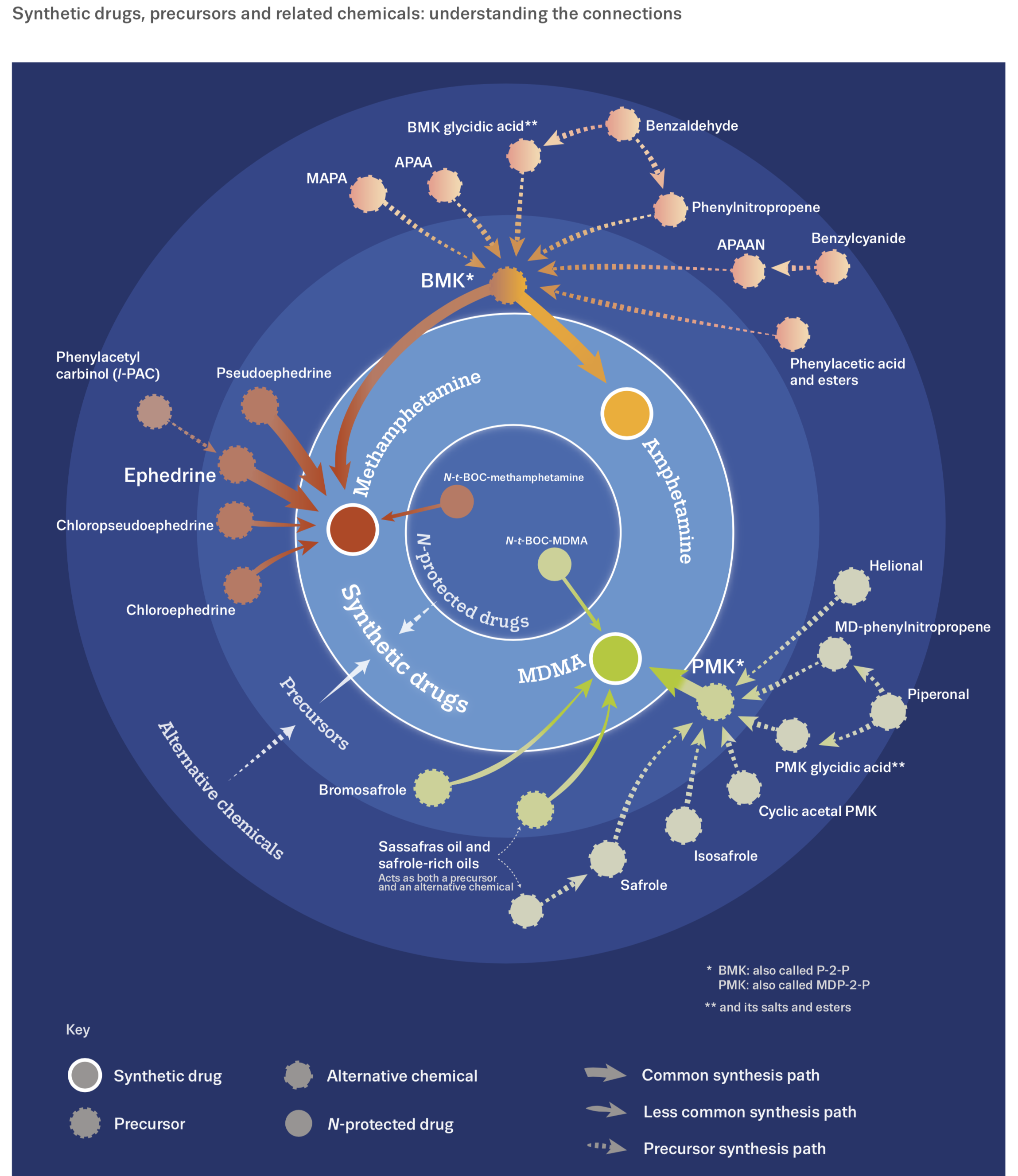
The EUDA monitors developments in drug precursor markets to support the early identification of emerging risks associated with these chemicals and to support informed responses at EU level (see Figure 2). This work covers controlled precursors and non-scheduled substances, including so-called ‘designer’ chemicals, used in illicit drug production, and contributes to a shared EU understanding of precursor-related risks.
For more information, see Drug precursor developments in the European Union.
Show a text version of the above graphic
This figure shows how synthetic drugs are chemically linked to the substances used to make them.
Main drugs shown
- Methamphetamine
- Amphetamine
- MDMA (ecstasy)
Types of related substances
- Precursors: chemicals directly used to make the drug
- Alternative chemicals: substances used when standard precursors are restricted
- N-protected drugs: modified forms of drugs used as intermediates
The table below of source data used to create the figure shows the relationship between different precursors and alternative chemicals and the target drug.
| Starting Chemical | Type | Type of path | Destination chemical |
|---|---|---|---|
| МАРА | Alternative chemicals | Precursor synthesis path | BMK |
| АРАА | Alternative chemicals | Precursor synthesis path | BMK |
| BMK glycidic acid (and its salts and esters) | Alternative chemicals | Precursor synthesis path | BMK |
| Benzaldehyde | Alternative chemicals | Precursor synthesis path | BMK glycidic acid** |
| Benzaldehyde | Alternative chemicals | Precursor synthesis path | Phenylnitropropene |
| Phenylnitropropene | Alternative chemicals | Precursor synthesis path | BMK |
| APAAN | Alternative chemicals | Precursor synthesis path | BMK |
| Benzylcyanide | Alternative chemicals | Precursor synthesis path | APAAN |
| Phenylacetic acid and esters | Alternative chemicals | Precursor synthesis path | BMK |
| BMK | Precursor | Common synthesis path | Amphetamine |
| Helional | Alternative chemicals | Precursor synthesis path | PMK |
| MD-phenyInitropropene | Alternative chemicals | Precursor synthesis path | PMK |
| Piperonal | Alternative chemicals | Precursor synthesis path | MD-phenyInitropropene |
| Piperonal | Alternative chemicals | Precursor synthesis path | PMK glycid acid (and its salts and esters) |
| PMK glycid acid (and its salts and esters) | Alternative chemicals | Precursor synthesis path | PMK |
| Cyclic acetal PMK | Alternative chemicals | Precursor synthesis path | PMK |
| Isosafrole | Alternative chemicals | Precursor synthesis path | PMK |
| Safrole | Alternative chemicals | Precursor synthesis path | PMK |
| Sassafras oil and safrole-rich oils | Alternative chemicals | Precursor synthesis path | Safrole |
| N-t-BOC-MDMA | N-protected drug | Less common synthesis path | MDMA |
| Sassafras oil and safrole-rich oils | Precursor | Less common synthesis path | MDMA |
| Bromosafrole | Precursor | Less common synthesis path | MDMA |
| PMK | Precursor | Common synthesis path | MDMA |
| Phenylacetyl carbinol (I-PAC) | Alternative chemicals | Precursor synthesis path | Ephedrine |
| N-t-BOC-methamphetamine | N-protected drug | Less common synthesis path | Methamphetamine |
| Chloroephedrine | Precursor | Less common synthesis path | Methamphetamine |
| Chloropseudoephedrine | Precursor | Less common synthesis path | Methamphetamine |
| Ephedrine | Precursor | Common synthesis path | Methamphetamine |
| Pseudoephedrine | Precursor | Common synthesis path | Methamphetamine |
| BMK | Precursor | Common synthesis path | Methamphetamine |
| BMK: also called P-2-P PMK: also called MDP-2-P |
|||
The work focuses on:
- monitoring developments related to the diversion and trafficking of drug precursors across the European Union
- supporting the implementation of existing EU precursor regulation by providing evidence relevant to the listing, delisting or re-categorisation of substances
- providing technical support to Member States and the European Commission on matters related to precursor chemicals
- assessing the risks associated with specific precursor chemicals.
This approach is aligned with Regulation (EU) 2023/1322 and with established EUDA drug supply monitoring methodologies, as well as EU early warning and risk assessment processes. Activities include the issuing notifications when new precursors are detected for the first time in the European Union, analysis of precursor-related signals, and the preparation of drug precursor assessments.
Drug precursor assessments may be initiated following formal requests from Member States or the European Commission, in line with Article 14(2) of Regulation (EU) 2023/1322. These assessments provide structured, evidence-based evaluations of substances to inform EU-level consideration of potential control measures.
For queries on drug precursors, contact us at precursors@euda.europa.eu.
Precursor assessment reports
Precursor assessment reports provide structured, evidence-based evaluations of individual substances or groups of substances with respect to their use in illicit drug production. Each report summarises the substance’s role in illicit drug production, patterns of diversion and supply, and associated risks, supporting a coherent EU-level understanding of precursor-related developments. Sections of the reports that contain detailed methodology or technical information that could be misused to enable illicit synthesis are withheld in the interest of public safety. Access to the unredacted reports is restricted and will only be provided to verified law-enforcement or regulatory authorities upon request to precursors@euda.europa.eu.
List of published reports
- Precursor assessment report of phenyl-2-nitropropene [ref. PAR-9], ()
This precursor is associated with the production of amphetamine. - Precursor assessment report of 2-bromo-4′-chloropropiophenone [ref. PAR-8], ()
This precursor is associated with the production of Clephedrone (4-CMC). - Precursor assessment report of 4’-chloropropiophenone [ref. PAR-7], ()
This precursor is associated with the production of Clephedrone (4-CMC ). - Precursor assessment report of 2-bromo-3′-methylpropiophenone [ref. PAR-6], ()
This precursor is associated with the production of 3- methylmethcathinone (3-MMC). - Precursor assessment report of 3′-methylpropiophenone [ref. PAR-5], ()
This precursor is associated with the production of 3-methylmethcathinone (3-MMC). - Precursor assessment report of 2-bromo-4′-methylpropiophenone [ref. PAR-4], ()
This precursor is associated with the production of mephedrone (4-MMC). - Precursor assessment report of 4′-methylpropiophenone [ref. PAR-3], ()
This precursor is associated with the production of mephedrone (4-MMC). - Precursor assessment report of 2-bromo-3′-chloropropiophenone [ref. PAR-2], ()
This precursor is associated with the production of clophedrone (3-CMC). - Precursor assessment report of 3′-chloropropiophenone [ref. PAR-1], ()
This precursor is associated with the production of clophedrone (3-CMC).
Contact
For enquiries, please contact us at precursors@euda.europa.eu.