


Wastewater analysis and drugs — a European multi-city study

Introduction
The analysis of municipal wastewater for drugs and their metabolic products to estimate community consumption is a developing field, involving scientists working in different research areas, including analytical chemistry, physiology, biochemistry, sewage engineering, spatial epidemiology and statistics, and conventional drug epidemiology. This page presents the findings from studies conducted since 2011. Data from all studies can be explored through an interactive tool, and a detailed analysis of the findings of the most recent study, in 2025, is presented.
See our wastewater analysis hub page for more resources on this topic.
Page last updated: 18 March 2026
Data explorer
Please note that due to the large amount of data involved processed on this page, it may take some moments before all content appears.
In this section you can explore the data from the most recent study in 2025, as well as from previous studies. Each study reveals a picture of distinct geographical and temporal patterns of drug use across European cities. Clicking on a symbol in the graph or the map will show more detailed information for a given wastewater treatment plant. You can also select a site from the drop-down menu.
Analysis: results from a European multi-city study
The findings of the largest European project to date in the emerging science of wastewater analysis are presented in this section. The project analysed wastewater in around 115 European cities and towns (referred to as ‘cities’) to explore the drug-taking habits of those who live in them. The results provide a valuable snapshot of the drug flow through the cities involved, revealing marked geographical variations.
Wastewater analysis is now an established method within the epidemiological toolkit in Europe and internationally, used to monitor geographical and temporal trends in illicit drug use, with the potential to capture near real‑time data. Originally used in the 1990s to monitor the environmental impact of liquid household waste, the method has since been used to estimate illicit drug consumption in different cities (Daughton, 2001; van Nuijs et al., 2011; Zuccato et al., 2008). It involves sampling a source of wastewater, such as a sewage influent to a wastewater treatment plant. This allows scientists to estimate the quantity of drugs consumed by a community by measuring the levels of illicit drugs and their metabolites excreted in urine (Zuccato et al., 2008).
Wastewater testing in European cities
In 2010, a Europe-wide network (Sewage analysis CORe group — Europe (SCORE)) was established with the aim of standardising the approaches used for wastewater analysis and coordinating international studies through the establishment of a common protocol of action. The first activity of the SCORE group was a Europe-wide investigation, performed in 2011 in 19 European cities, which allowed the first ever wastewater study of regional differences in illicit drug use in Europe (Thomas et al., 2012). That study included the first intercalibration exercise for the evaluation of the quality of the analytical data and allowed a comprehensive characterisation of the major uncertainties of the approach (Castiglioni et al., 2014). Following the success of this initial study, comparable studies were undertaken over the following years, covering 115 cities and 25 countries in the European Union, Norway and Türkiye in 2025. A standard protocol and a common quality control exercise were used in all locations, which made it possible to directly compare illicit drug loads in Europe over a one-week period during 10 consecutive years (van Nuijs et al., 2018). Raw 24-hour composite samples were collected during a single week between March and May 2025 in the majority of the cities. These samples were analysed for the urinary biomarkers (i.e. measurable characteristics) of the parent drug (i.e. primary substance) for amphetamine, methamphetamine, ketamine and MDMA. In addition, the samples were analysed for the main urinary metabolites (i.e. substances produced when the body breaks drugs down) of cocaine and cannabis, which are benzoylecgonine (BE) and THC-COOH (11-nor-9-carboxy-delta9-tetrahydrocannabinol), respectively.
The specific metabolite of heroin, 6-monoacetylmorphine, has been found to be unstable in wastewater. Consequently, the only alternative is to use morphine, although it is not a specific biomarker and can also be excreted as a result of therapeutic use. This underlines the importance of collecting the most accurate figures for morphine use from prescription and sales reports.
Patterns of illicit drug use: geographical and temporal variation
2025 key findings
The project findings revealed distinct geographical and temporal patterns of drug use across European cities (see the data explorer).
The annual SCORE wastewater sampling presented here, from 115 cities, showed that, overall, the loads of the different stimulant drugs detected in wastewater in 2025 varied considerably across study locations, although all illicit drugs investigated were found in almost every city that participated. Unless otherwise stated, comparisons between 2024 and 2025 relate only to those cities with data for both years.
From 2024 to 2025, overall, the load of the cocaine metabolite benzoylecgonine (BE) detected in wastewater in European cities increased by 22%. City-level wastewater data indicate that cocaine use remains highest in the west and south of Europe, notably in cities in Belgium, the Netherlands and Spain. Low levels were found in the majority of cities in the east of Europe, although the most recent data continue to show signs of increase.
Overall, little difference was found in the overall loads of amphetamine and methamphetamine detected in wastewater in European cities between 2024 and 2025. The loads of amphetamine detected in wastewater varied considerably across study locations, with the highest levels being reported in cities in the north and centre of Europe. Amphetamine was found at much lower levels in cities in the south of Europe, although with the most recent data showing some signs of increase. The highest loads were found in cities in Norway, Sweden, Denmark, Belgium, the Netherlands and Germany.
Methamphetamine use, generally low in most cities and historically concentrated in Czechia and Slovakia, was also evident from wastewater in Germany, Lithuania, Norway, Türkiye, Spain, Cyprus and the Netherlands. The observed methamphetamine loads in wastewater in other locations were very low, although the most recent data show signals of increases in cities in the centre and north of Europe.
From 2024 to 2025, the overall loads of MDMA detected in wastewater in European cities decreased by almost 16%. The highest loads of MDMA were found in cities in Belgium, Spain and the Netherlands.
From 2024 to 2025, the overall loads of cannabis metabolites detected in wastewater in European cities remained stable. The highest loads of the cannabis metabolite THC-COOH were found in cities in the Netherlands, Germany and Slovenia.
From 2024 to 2025, the overall loads of ketamine detected in wastewater in European cities increased by almost 41%. For ketamine, the highest loads were found cities in Belgium, Germany, and the Netherlands.
Nineteen countries participating in the 2025 monitoring campaign included two or more study locations (Belgium, Czechia, Denmark, Germany, Spain, Croatia, Italy, Cyprus, Lithuania, Hungary, Netherlands, Austria, Portugal, Slovenia, Slovakia, Finland, Sweden, Norway, Türkiye). The study highlighted differences between cities within the same country for the substances most commonly detected, which may be partly explained by differences in the social and demographic characteristics of the cities, such as the presence of universities, nightlife areas and population age structure. Interestingly, in the majority of countries with multiple study locations, no marked differences were found for most substances when comparing the largest city in each country with smaller cities; the exceptions were cocaine and MDMA.
In addition to geographical patterns, wastewater analysis can detect fluctuations in weekly patterns of illicit drug use. More than 75% of the cities show higher loads of the cocaine metabolite BE and MDMA in wastewater during the weekend (Friday to Monday) than during weekdays. Around 50% of the cities show this pattern for ketamine. In contrast, cannabis (THC-COOH), amphetamine and methamphetamine use was found to be distributed more evenly over the whole week.
Eighty-four cities have participated in at least five of the annual wastewater monitoring campaigns since 2011. This allows for time trend analysis of drug consumption based on wastewater testing.
Cannabis
Cannabis is Europe’s most commonly used illicit drug, with an estimated 24 million last year users. National surveys of cannabis use would suggest that, overall, around 8.4% of European adults (24 million aged 15 to 64) have used cannabis in the last year. However, both the level of use and trends in use reported in recent national data appear heterogeneous (EUDA, 2025).
In wastewater, cannabis use is estimated by measuring its main metabolite, THC-COOH, which is the only suitable biomarker found so far. Although it is excreted in a low percentage and more research is still needed (Causanilles et al., 2017), it is commonly used to report on cannabis use in the literature (Zuccato et al., 2016; Bijlsma et al., 2020).
All European cities detected THC-COOH in wastewater. The THC-COOH loads observed indicate that cannabis use was highest in cities in the west and centre of Europe, in particular in cities in the Netherlands, Germany, but also in cities in Slovenia. Viewed in a global context, wastewater analysis indicates higher THC-COOH levels in cities in Canada and the United States than in the EU cities with the highest observed loads.
From 2024 to 2025, overall, the load of cannabis metabolites detected in wastewater in European cities remained stable. In 2025, there were diverging trends among the 63 cities with data for both years: 21 (33%) cities reported an increase in THC-COOH loads in wastewater samples, while 28 (44%) showed a decrease and 14 (22%) remained stable.
Figure 1. Relative geographical distribution of cannabis metabolite as detected in European cities, 2025 (daily mean)
Figure 2. Changes in the mean weekly cannabis metabolites from wastewater analyses in selected European cities between 2024 and 2025
Cocaine
The BE loads observed in wastewater indicate that cocaine use remains highest in cities in the west and south of Europe, in particular in cities in Belgium, the Netherlands and Spain. BE was detected in the wastewater in all participating European cities. Low levels were found in the majority of the cities in the east of Europe, but the most recent data continues to show signs of increases. Viewed in a global context, cities in Canada, Chile, Switzerland and the United Kingdom show BE loads similar to or higher than the EU cities with the highest observed loads.
Figure 3. Relative geographical distribution of cocaine metabolite as detected in European cities, 2025 (daily mean)
A relatively stable picture of cocaine use was observed between 2011 and 2015 in most cities. However, 2016 marked a turning point, with increases observed in the majority of cities each year since then. From 2024 to 2025, overall, the loads of the cocaine metabolite BE detected in wastewater in European cities increased by 22%. The 2025 data revealed further increases in cocaine residues in most cities when compared to 2024 data, with 48 (57%) out of 85 cities with data for both years reporting an increase, while 21 (25%) cities reported no change and 16 (19%) cities reported a decrease. An overall increase is seen for all 10 cities with data for both 2011 and 2025.
Figure 4. Changes in the mean weekly cocaine metabolites from wastewater analyses in selected European cities between 2024 and 2025
In approximately half the countries with multiple study locations, higher BE loads (amounts of BE per 1 000 people) were found in the largest city compared with smaller cities. In addition to geographical patterns, wastewater analysis can detect fluctuations in weekly patterns of illicit drug use. More than 75% of the cities show higher loads of BE in wastewater during the weekend (Friday to Monday) than during weekdays, which may reflect a pattern of more recreational use.
MDMA
The highest loads of MDMA were found in the wastewater in cities in Belgium, Spain, the Netherlands and Slovenia. Across Europe, only one city did not detect MDMA in its wastewater. Viewed in a global context, only cities in New Zealand show MDMA loads comparable to the EU cities with the highest observed loads.
Figure 5. Relative geographical distribution of MDMA residues as detected in European cities, 2025 (daily mean)
Figure 6. Changes in the mean weekly MDMA metabolites from wastewater analyses in selected European cities between 2024 and 2025
From 2024 to 2025, overall, the loads of MDMA detected in wastewater in European cities decreased by almost 16%. Looking at longer-term trends in wastewater analysis, in most cases the loads of MDMA increased between 2011 and 2016 and have fluctuated since then. In 2020, possibly due to the closure of nightlife settings for long periods in the majority of countries, almost half of the cities (24 of 49, 49%) reported a decrease, with 18 (37%) reporting an increase. In 2021, 38 out of 58 cities (66%), reported a decrease. In 2022, 28 out of 62 cities (45%) reported an increase and 27 (44%) a decrease. Of the 78 cities that have data on MDMA residues in municipal wastewater for 2024 and 2025, 48 (62%) cities reported a decrease (mostly in cities in Austria, Germany and Slovenia), 12 (15%) a stable situation and 18 (23%) an increase (with no clear geographical pattern).
In contrast to recent years, most countries with multiple study locations reported marked differences between the largest cities and smaller cities, with higher MDMA loads (amounts of MDMA found in a location per 1 000 people) observed in the largest cities. More than 75% of the cities showed higher loads of MDMA in wastewater during the weekend (Friday to Monday) than during weekdays, reflecting the predominant use of MDMA in recreational settings.
Amphetamine and methamphetamine
Amphetamine and methamphetamine, two closely related stimulants, are both consumed in Europe, although amphetamine is much more commonly used. Methamphetamine consumption has historically been restricted to Czechia and, more recently, Slovakia, although recent years have seen increases in use in other countries.
Overall, little difference was found in the loads of amphetamine and methamphetamine detected in wastewater in European cities between 2024 and 2025. However, the loads of amphetamine detected in wastewater varied considerably across study locations, with the highest levels reported in cities in the north and centre of Europe. The highest loads were found in cities in Norway, Sweden, Denmark, Belgium, the Netherlands and Germany. Amphetamine was found at much lower levels in cities in the south of Europe, with the lowest loads in cities in Türkiye, Italy and Cyprus. Although the most recent data shows some signs of increase. Across Europe, three cities, located in Portugal and Slovenia, reported no detection of amphetamine in their wastewater. Viewed in a global context, wastewater analysis indicates lower levels of amphetamine in cities outside the European Union than in the EU cities with the highest observed loads.
Figure 7. Relative geographical distribution of amphetamine residues as detected in European cities, 2025 (daily mean)
To examine the data, use the data explorer, also available on this page. Underlying data is available in source data.
Figure 8. Changes in the mean weekly amphetamine metabolites from wastewater analyses in selected European cities between 2024 and 2025
Methamphetamine use, generally low and historically concentrated in Czechia and Slovakia, also appears to be present in Germany, Lithuania, Norway, Türkiye, Spain, Cyprus and the Netherlands. The observed methamphetamine loads in the other locations were low, with the most recent data showing signals of increases in cities in the north and centre of Europe. At the same time, 16 monitored European cities reported no detection of methamphetamine. Viewed in a global context, cities in Australia, Canada and the United States show higher methamphetamine loads than the EU cities with the highest observed loads.
Figure 9. Relative geographical distribution of methamphetamine residues as detected in European cities, 2025 (daily mean)
Overall, data from the 15 wastewater monitoring campaigns show no major changes in the general patterns of amphetamine and methamphetamine use. However, since 2021, several cities in countries with historically low or negligible use have reported increases for both substances.
Of the 82 cities with data on amphetamine residues for both 2024 and 2025, 36 (44%) reported an increase in the loads of amphetamine found in 2025, 27 (33%) showed a decrease and 19 (23%) remained stable. Of the 80 cities that reported data on methamphetamine residues in municipal wastewater for 2024 and 2025, 37 (46%) showed an increase, 28 (35%) a decrease and 15 (19%) a stable situation.
Figure 10. Changes in the mean weekly methamphetamine metabolites from wastewater analyses in selected European cities between 2024 and 2025
In 2025, around half of the cities show similar loads of amphetamine and methamphetamine during weekends (Friday to Monday) and weekdays.
Ketamine
From 2024 to 2025, overall, the loads of ketamine detected in wastewater in European cities increased by 41%. Of the 66 cities that have data on ketamine residues for 2024 and 2025, 40 (61%) reported an increase, with the largest relative increases observed in cities in Slovenia, Portugal and Sweden. Of the remaining cities, 14 (21%) showed stable levels and 12 (18%) reported a decrease. In 2025, the highest loads were detected in cities in Belgium, Germany and the Netherlands. By contrast, 9 cities, located in Belgium, Cyprus, Lithuania, Hungary and Slovenia, reported no detection of ketamine residues. Viewed in a global context, cities in Canada and the United Kingdom show higher levels of use than the EU cities with the highest observed loads.
Figure 11. Relative geographical distribution of ketamine residues as detected in European cities, 2025 (daily mean)
Around 50% of the cities showed higher loads of ketamine in wastewater during the weekend (Friday to Monday) than during weekdays, reflecting the predominant use of ketamine in recreational settings.
Figure 12. Changes in the mean weekly ketamine metabolites from wastewater analyses in selected European cities between 2024 and 2025
Limitations of this method
Wastewater analysis is an established method for monitoring the quantities of illicit drugs used at the population level, but it cannot provide information on prevalence and frequency of use, main classes of users and purity of the drugs. Additional challenges arise from uncertainties associated with the behaviour of the selected biomarkers in wastewater, different back-calculation methods and different approaches to estimate the size of the population being tested (Castiglioni et al., 2013, 2016; EMCDDA, 2016; Lai et al., 2014). The caveats in selecting the analytical targets for heroin, for example, make monitoring this drug in wastewater more complicated compared to other substances (Been et al., 2015). Also, the purity of street products fluctuates unpredictably over time and in different locations. Furthermore, translating the total consumed amounts into the corresponding number of average doses is complicated, as drugs can be taken by different routes and in amounts that vary widely, and purity levels fluctuate (Zuccato et al., 2008).
Wastewater-based epidemiology has been explored recently as a tool for monitoring the use of new psychoactive substances, as it can support early warning systems by identifying new substances and providing information on the substances used. New psychoactive substances present wastewater-based epidemiology with specific challenges in the detection of biomarkers, such as the low prevalence of use, and hence the low level of the drugs in the wastewater; their use being limited to certain sub-populations; the wide range of substances available on the market; the lack of information on their metabolism, biotransformation and stability in wastewater. Despite these limitations, the few studies performed so far are very promising, and further research will allow the routine application of wastewater-based epidemiology to monitor the use of new psychoactive substances in the population.
Wastewater-based epidemiology consists of several consecutive steps that allow researchers to identify and quantify target metabolic residues of illicit drugs in raw wastewater and back-calculate the amount of the corresponding illicit drugs consumed by the population served by the wastewater treatment plant. It is important to note that for some cities, wastewater samples are not fully representative of drug use for the entire population of that city.
Efforts are being made to enhance wastewater monitoring approaches. For example, work has been undertaken on overcoming a major source of uncertainty related to estimating the number of people present in a sewer catchment at the time of sample collection. This involved using data from mobile devices to better estimate the dynamic population size for wastewater-based epidemiology (Thomas et al., 2017).
Terms and definitions
In addition to the glossary below, see also Frequently-asked questions on wastewater-based epidemiology and drugs.
Back-calculation
Back-calculation is the process whereby researchers calculate/estimate the consumption of illicit drugs in the population based on the amounts of the target drug residue entering the wastewater treatment plant.
LC-MS/MS
Liquid chromatography–tandem mass spectrometry (LC-MS/MS) is the analytical method most commonly used to quantify drug residues in wastewater. LC-MS/MS is an analytical chemistry technique that combines the separation techniques of liquid chromatography with the analysis capabilities of mass spectrometry. Considering the complexity and the low concentrations expected in wastewater, LC-MS/MS is one of the most powerful techniques for this analysis, because of its sensitivity and selectivity.
Metabolite
Traces of drugs consumed will end up in the sewer network either unchanged or as a mixture of metabolites. Metabolites, the end products of metabolism, are the substances produced when the body breaks drugs down.
Residue
Wastewater analysis is based on the fact that we excrete traces in our urine of almost everything we consume, including illicit drugs. The target drug residue is what remains in the wastewater after excretion and is used to quantify the consumption of illicit drugs in the population.
Urinary biomarkers
Analytical chemists look for urinary biomarkers (measurable characteristics to calculate population drug use) in wastewater samples, which can be the parent drug (i.e. the primary substance) or its urinary metabolites.
Enantiomeric profiling
Enantiomeric profiling is an analytical chemistry technique used to determine if studied drugs in wastewater originate from consumption or direct disposal (e.g. production waste). It is based on the fact that chiral molecules (if only one chiral centre is present) exist as two enantiomers (opposite forms) which are non-superimposable mirror images of each other. As the enantiomeric ratio will change after human metabolism, the enantiomeric fraction can be used to determine whether the studied drugs in wastewater originate from consumption.
Methods and ethical considerations
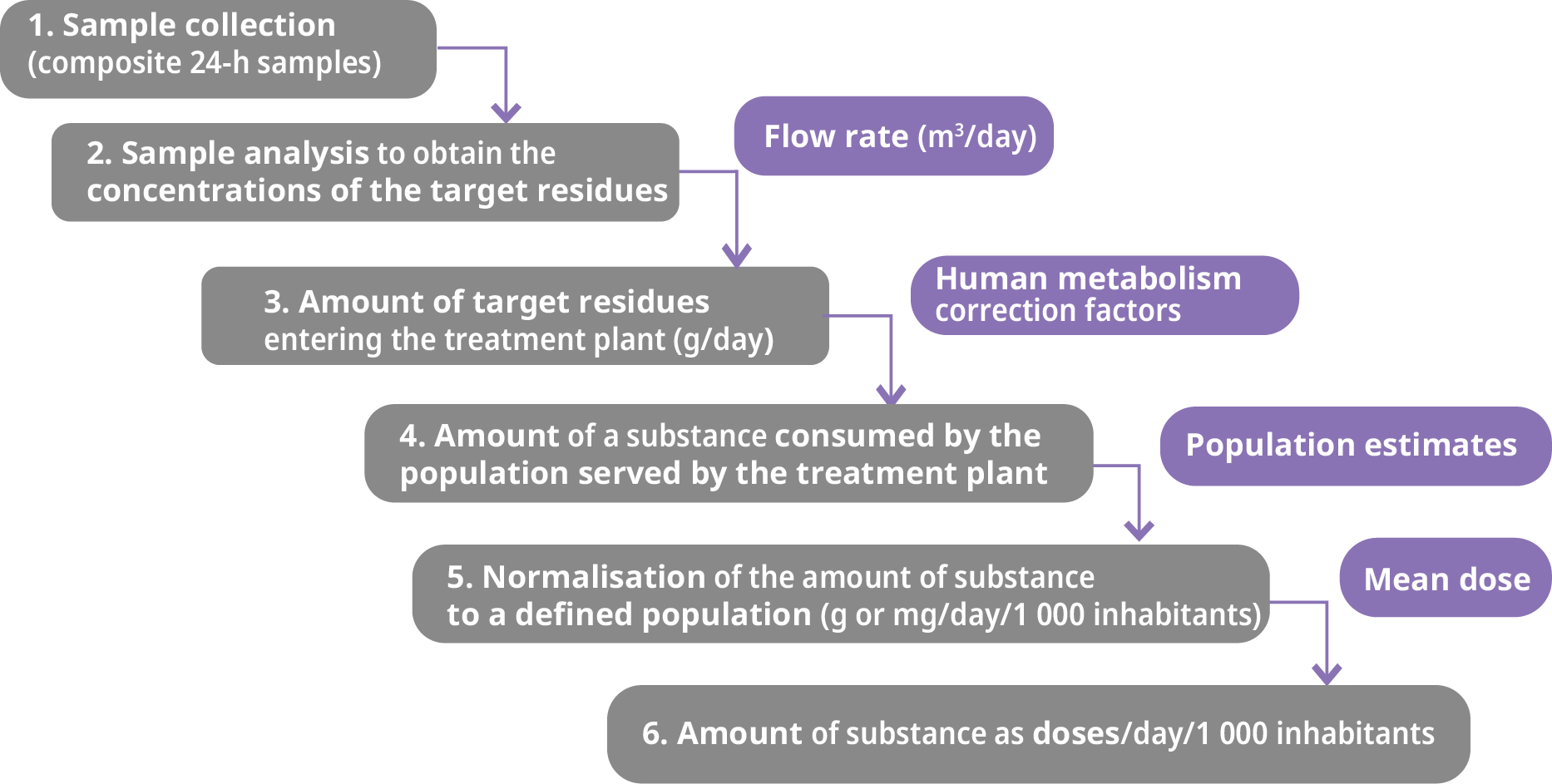
In order to estimate levels of drug use from wastewater, researchers attempt first to identify and quantify drug residues, and then to back-calculate the amount of the illicit drugs used by the population served by the sewage treatment plants (Castiglioni et al., 2014). This approach involves several steps (see figure). Initially, composite samples of untreated wastewater are collected from the sewers in a defined geographical area. The samples are then analysed to determine the concentrations of the target drug residues. Following this, the drug use is estimated through back-calculation by multiplying the concentration of each target drug residue (nanogram/litre) with the corresponding flow of sewage (litre/day). A correction factor for each drug is taken into account as part of the calculation. In a last step, the result is divided by the population served by the wastewater treatment plant, which shows the amount of a substance consumed per day per 1 000 inhabitants. Population estimates can be calculated using different biological parameters, census data, number of house connections, or the design capacity, but the overall variability of different estimates is generally very high.
Show a text version of the above graphic
Image shows steps in sampling process for wastewater. Step 1. Sample collection (composite 24 hour samples). Step 2. Sample analysis to obtain the concentrations of the target residues (Flow rate in cubic metres per day). Step 3. Amount of target residues entering the treatment plant in grams per day. Human metabolism correction factors are applied. Step 4. Calculate amount of substance consumed by the population served by the treatment plant, based on population estimates. Step 5. Normalisation of the amount of substance to a defined population in g or mg per day per 1000 inhabitants. Step 6. To calculate mean doses, final value is expressed as doses per day per 1000 inhabitants
Although primarily used to study trends in illicit drug consumption in the general population, wastewater analysis has also been applied to small communities, including workplaces, schools (Zuccato et al., 2017), music festivals, prisons (Néfau et al., 2017) and specific neighbourhoods (Hall et al., 2012).
Using this method in small communities can involve ethical risks (Prichard et al., 2014), such as possible identification of a particular group within the community.
In 2016 the SCORE group published ethical guidelines for wastewater-based epidemiology and related fields (Prichard et al., 2016). The objective of these guidelines is to outline the main potential ethical risks for wastewater research and to propose strategies to mitigate those risks. Mitigating risks means reducing the likelihood of negative events and/or minimising the consequences of negative events.
References
Been, F., Benaglia, L., Lucia, S., et al. (2015), ‘Data triangulation in the context of opioids monitoring via wastewater analyses', Drug and Alcohol Dependence 151, pp. 203–210.
Bijlsma, L., Burgard, D., Been, F., et al. (2020), ‘The estimation of cannabis consumption through wastewater analysis', Comprehensive Analytical Chemistry, 90, pp. 453–482.
Castiglioni, S., Bijlsma, L., Covaci, A., et al. (2013), ‘Evaluation of uncertainties associated with the determination of community drug use through the measurement of sewage drug biomarkers', Environmental Science and Technology 47(3), pp. 1452–1460.
Castiglioni, S., Thomas, K. V., Kasprzyk-Hordern, B., Vandam, L. and Griffiths, P. (2014), ‘Testing wastewater to detect illicit drugs: State of the art, potential and research needs', Science of the Total Environment 487, pp. 613–620.
Castiglioni, S., Borsotti, A., Riva, F. and Zuccato, E. (2016), ‘Illicit drug consumption estimated by wastewater analysis in different districts of Milan: A case study', Drug and Alcohol Review 35, pp. 128–132.
Causanilles, A., Baz-Lomba, J. A., Burgard, D. A., et al. (2017), ‘Improving wastewater-based epidemiology to estimate cannabis use: Focus on the initial aspects of the analytical procedure', Analytica Chimica Acta 988, pp. 27–33.
Daughton, C. G. (2001), ‘Emerging pollutants, and communicating the science of environmental chemistry and mass spectrometry: Pharmaceuticals in the environment', American Society for Mass Spectrometry 12, pp. 1067–1076.
EMCDDA (2016), Assessing illicit drugs in wastewater: Advances in wastewater-based drug epidemiology, Publications Office of the European Union, Luxembourg.
European Union Drugs Agency (2025), European drug report 2025: trends and developments, https://www.euda.europa.eu/publications/european-drug-report/2025_en.
Hall, W., Prichard, J., Kirkbride P., Bruno, R., Thai, P. K., Gartner, C. et al. (2012), ‘An analysis of ethical issues in using wastewater analysis to monitor illicit drug use', Addiction 107(10), pp. 1767–1773
Lai, F. Y., Anuj, S., Bruno, R., et al. (2014), ‘Systematic and day-to-day effects of chemical-derived population estimates on wastewater-based drug epidemiology', Environmental Science and Technology 49, pp. 999–1008.
Néfau, T., Sannier, O., Hubert, C., Karolak, S. and Lévi, Y. (2017), Analysis of drugs in sewage: an approach to assess substance use, applied to a prison setting, Observatoire Français des Drogues et des Toxicomanies, Paris.
Prichard, J., Hall, W., de Voogt, P. and Zuccato, E. (2014), ‘Sewage epidemiology and illicit drug research: the development of ethical research guidelines', Science of the Total Environment 47(2), pp. 550–555.
Prichard, J., Hall, W., Zuccato, E., de Voogt, P., Voulvoulis, N., Kummerer, K., Kasprzyk-Hordern, B., et al. (2016), ‘Ethical research guidelines for wastewater-based epidemiology and related fields' (www.emcdda.europa.eu/drugs-library/ethical-research-guidelines-wastewater-based-epidemiology-and-related-fields_en).
Thomas, K. V., Bijlsma, L., Castiglioni, S., et al. (2012), ‘Comparing illicit drugs use in 19 European cities through sewage analysis', Science of the Total Environment 432, pp. 432–439.
Thomas, K. V., Amador, A., Baz-Lomba, J. A. and Reid, M. (2017), ‘Use of mobile device data to better estimate dynamic population size for wastewater-based epidemiology', Environmental Science and Technology 51(19), pp.11363–11370.
van Nuijs, A., Mougel, J.-F., Tarcomnicu, I., et al. (2011), ‘Sewage epidemiology: A real-time approach to estimate the consumption of illicit drugs in Brussels, Belgium', Environment International 27, pp. 612–621.
van Nuijs, A., Lai, Y., Been, F., et al. (2018), ‘Multi-year inter-laboratory exercises for the analysis of illicit drugs and metabolites in wastewater: Development of a quality control system', Trends in Analytical Chemistry 103, pp. 34–43.
Zuccato, E., Chiabrando, C., Castiglioni, S., Bagnati, R. and Fanelli, R. (2008), ‘Estimating community drug abuse by wastewater analysis', Environmental Health Perspectives 116(8), pp. 1027–1032.
Zuccato, E., Gracia-Lor, E., Rousis, N. I., Parabiaghi, A., Senta, I., Riva, F. and Castiglioni, S. (2017), ‘Illicit drug consumption in school populations measured by wastewater analysis', Drug and Alcohol Dependence 178, pp. 2852–2890.
Find out more
- Wastewater and drugs topic hub
- Frequently asked questions on wastewater-based epidemiology and drugs
- Assessing illicit drugs in wastewater: Advances in wastewater-based drug epidemiology (2016)
- Wastewater-based drug epidemiology explainer video
Source data
General notes on the data
- Population-normalised loads: All values indicate the amount of drug residues quantified in raw sewage. No values were corrected with excretion factors.
- Cities with multiple sewage treatment plants (STPs): The numbers or letters in brackets specify the STPs, which provided data for the corresponding city in this study. For example, Berlin (4) indicates the population-weighted average of four different STPs in the city of Berlin.
- Values below the limit of quantification: Values below the method limit of quantification are indicated as zero.
- Weekday means are averages of Tuesdays, Wednesdays and Thursdays.
- Weekend means are averages of Fridays, Saturdays, Sundays and Mondays.
- Usually, there is at least one sample taken on each weekday. In case data is missing for a day, the averages are calculated over non-missing observations.
Using the data
- The data may be re-used in your own work provided the source (EUDA and SCORE) are acknowledged.
- In addition to data values, a site information table is provided with information on the treatment plants where the measurements were made. Each site is identified with a unique arbitrary ID (‘SiteID’), which provides information on the location of the site, the institution responsible and the approximate population served (the population values presented are indicative only and not necessarily the ones used at the time of the collection). This ID is referred to in each data table.
Substance-specific notes
- Benzoylecgonine: this is the main excreted metabolite of cocaine.
- THC-COOH: this is the main excreted metabolite of cannabis.
Site-specific notes
- Results in Bologna and Rome (Italy) were provided thanks to funding by Dipartimento Politiche Antidroga.
You can download the source data for drugs in wastewater in cities from our data catalogue or use the links below to directly download the CSV files.