


MDMA – the current situation in Europe (European Drug Report 2023)
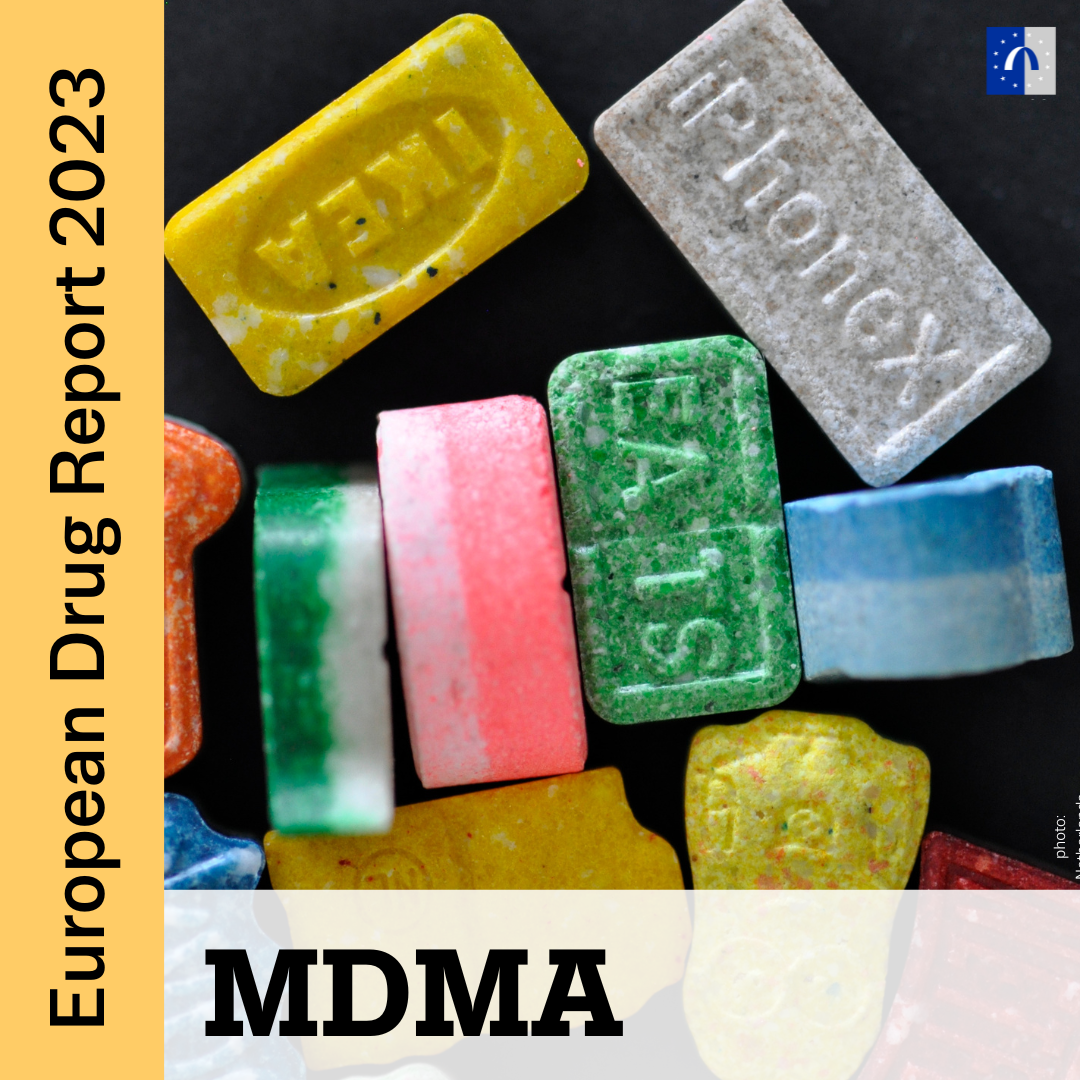
MDMA is a synthetic drug chemically related to the amphetamines, but with somewhat different effects. In Europe, MDMA use has generally been associated with episodic patterns of consumption in the context of nightlife and entertainment settings. On this page, you can find the latest analysis of the drug situation for MDMA in Europe, including prevalence of use, seizures, price and purity and more.
This page is part of the European Drug Report 2023, the EMCDDA's annual overview of the drug situation in Europe.
Last update: 16 June 2023
User awareness of MDMA product strength remains a concern
MDMA is a synthetic drug chemically related to the amphetamines, but with somewhat different effects. In Europe, MDMA use has generally been associated with episodic patterns of consumption in the context of nightlife and entertainment settings. Reported use of the drug appeared to decline temporarily during periods of social distancing during the early phases of the COVID-19 pandemic. The currently available data would, however, suggest an overall relatively stable level of consumption but with national variations in the recent trends observed and the caveat that overall supply side indicators are suggestive of a slight recent decline in availability. About half of the European cities reporting wastewater analysis found an increase in MDMA residues between 2021 and 2022, although in most other cities some decline was noted.
Overall, available indicators suggest that MDMA production continues within Europe, both for domestic consumption and for export to non-EU markets. The information available is strongly suggestive that most MDMA production continues to be largely concentrated in or around the Netherlands. There are some signs of a reduction in the volume being manufactured in the most recent data. An important caveat here is that this information mostly covers the first years of the pandemic and needs to be interpreted with caution. The number of MDMA laboratories dismantled in the European Union decreased in 2021 compared with 2020, while seizures of precursor chemicals for manufacturing MDMA increased in 2021. In 2021, the quantity of MDMA tablets seized in the European Union declined by a quarter and the quantity of MDMA powder seized declined slightly. In addition, while overall the average MDMA content of tablets and purity of powders remained stable in 2021, a recent decrease in the MDMA content of ecstasy tablets was noted in some important source countries, most notably the Netherlands.
With a typical MDMA content of 150 to 170 milligrams, the overall strength of tablets available on the retail marketplace still remains high by historical standards. It is difficult to interpret the more recent data with any certainty, but a possible decline in production volumes and some reductions noted in MDMA tablet content may indicate that producers have experienced greater problems sourcing precursor chemicals or that some producers may have switched to producing other substances, either because of market demand or because they are more profitable. It may also reflect a perceived consumer demand for lower-strength products.
The use of MDMA is rarely cited as a reason for entering drug treatment in Europe but acute poisonings and deaths are sometimes associated with the consumption of this substance. The use of MDMA therefore continues to represent an important issue for prevention and harm reduction messaging and interventions.
The availability of higher strength products potentially increases the risk of adverse health outcomes associated with the consumption of this substance. Interestingly, a decline in MDMA-related presentations by a quarter was observed in sentinel hospital emergency departments with data for 2020 and 2021. This data set, however, is difficult to interpret in respect to overall trends, as it is not nationally representative, has limited coverage and may reflect either changes in consumption or reporting during the pandemic.
While it is again difficult to generalise due to limitations in national and European coverage, the available information from drug checking services suggests that MDMA products are generally less subject to adulteration than other illicit drugs they screened in 2021. This does occur however, as illustrated by the inclusion of synthetic cathinones in MDMA tablets observed on some occasions. These sorts of mixtures may also increase the risk to consumers of experiencing unexpected adverse effects and potential harm.
Key data and trends
Prevalence of MDMA use
- Surveys conducted by 26 EU countries between 2015 and 2022 suggest that 1.8 million young adults (15 to 34) used MDMA in the last year (1.8 % of this age group), with 2.0 % (0.9 million) of those aged 15 to 24 years estimated to have used MDMA in the last year.
- No overall trend emerges from the data on MDMA use. Of the 11 European countries that undertook surveys since 2020 and provided confidence intervals, 1 reported higher estimates than their previous comparable survey, 9 reported stable estimates and 1 reported a decrease.
This data explorer enables you to view our data on the prevalence of MDMA use by recall period and age range. You can access data by country by clicking on the map or selecting a country from the dropdown menu.
Prevalence data presented here are based on general population surveys submitted to the EMCDDA by national focal points. For the latest data and detailed methodological information please see the Statistical Bulletin 2023: Prevalence of drug use.
Graphics showing the most recent data for a country are based on studies carried out between 2013 and 2022. Age ranges are 16–34 for Denmark, Estonia and Norway; 17–34 for Sweden; 18–34 for Germany, Greece, France and Hungary.
- Of the 61 cities that have data on MDMA residues in municipal wastewater for 2021 and 2022, 28 reported an increase, 7 a stable situation and 26 a decrease. All of the 8 cities with data for both years had higher MDMA mass loads in 2022 than in 2011.
Red = increase | Green = decrease | Yellow = stable, with respect to previous value | Blue = no previous data
Mean daily amounts of MDMA in milligrams per 1000 population. Sampling was carried out over a week in March and April 2022.
Taking into account statistical errors, values that differ less than 10% from the previous value are considered stable in this figure.
Source: Sewage Analysis Core Group Europe (SCORE).
Hospital presentations related to MDMA
- MDMA was the seventh most common drug reported by Euro-DEN Plus hospitals in 2021, present in 5 % of acute drug toxicity presentations. Presentations involving MDMA decreased to 276 in 2021 (363 in 2020). Alcohol was co-used in most reported cases. The drugs most commonly found in association with MDMA were cocaine and cannabis, and in some centres also GHB/GBL, amphetamine and synthetic cathinones.
MDMA market data
- In 2021, EU countries reported 10 000 seizures of MDMA (13 000 in 2020). Seizures of MDMA powder in the European Union amounted to 1.6 tonnes (1.6 tonnes in 2020) and seizures of MDMA tablets reached 3.5 million (4.7 million in 2020). Türkiye seized 7.6 million MDMA tablets in 2021 (11.1 million in 2020) (see the MDMA market infographic, below).
- The Netherlands reported 12 MDMA laboratories in 2021 (21 in 2020), with Belgium reporting 2 and France 1. MDMA tableting sites were reported by Poland (2) and Spain (1). Seizures of MDMA precursors increased to 2.5 tonnes in 2021 compared with 2 tonnes in 2020.
- The average MDMA content in tablets and the purity of powders remained stable in 2021, with MDMA tablets seized in Europe containing on average between 161 and 173 milligrams of MDMA, and the average purity of seized MDMA powders ranging from 42 % to 100 %. The Netherlands, however, reported a lower average MDMA content of ecstasy tablets (148 mg per tablet).
EU+2 refers to EU Member States, Norway and Türkiye.
- During the first half of 2022, the average amount of MDMA per tablet tested by drug checking services in 9 cities in 5 EU Member States was 152 milligrams (166 milligrams in the same period of 2021). The average purity of MDMA powder reported was 78 % (80 % in first half of 2021).
Source data
The data used to generate infographics and charts on this page may be found below.
About this page
Recommended citation: European Monitoring Centre for Drugs and Drug Addiction (2023), European Drug Report 2023: Trends and Developments, https://www.emcdda.europa.eu/publications/european-drug-report/2023_en
Identifiers:
HTML: TD-AT-23-001-EN-Q
ISBN: 978-92-9497-865-3
DOI: 10.2810/161905